Key takeaways
- A Swedish parking sign is a stack: the main sign says what is allowed or banned, and every plate under it narrows when, how long, for whom and whether you pay.
- On the time plate, plain figures are weekdays (normally Monday to Friday), figures in brackets are the weekday before a Sunday or holiday (usually Saturday), and red figures are Sundays and holidays.
- Each plate is read on its own. A plate that says only Avgift means you pay around the clock, even when the next plate shows hours.
- A zone sign at the entrance to an area covers every street inside, and a no-parking ban starts again after a short exception without a new sign.
- Some rules apply with no sign at all: no parking within 10 metres before a pedestrian crossing or of a junction, only on the right-hand side, and at most 24 hours in a row on weekdays.
- Date parking and street-cleaning hours are set by each municipality, so the sign on the street decides.
- A parking fine is set by the municipality, between 75 and 1,300 kronor. You pay it first, then dispute it with the Police.
On this page · 13 sections
- Why Swedish parking signs feel hard
- The main signs
- How to read the time plate
- The other plates under the sign
- The signs that catch people out
- Rules that apply with no sign
- Date parking and street-cleaning nights
- What a parking fine costs, and how to dispute it
- Parking permit for people with disabilities
- A quick check before you walk away
- Frequently Asked Questions
- Moving for work? How Settio helps
- Sources
The short answer: read a Swedish parking sign from the top down. The main sign says whether parking is allowed or banned, and each plate under it adds a condition: the hours, the longest stay, a fee, who it is for. The plate newcomers misread most is the time plate, because the same sign can mean three different hours on a weekday, a Saturday and a Sunday. And some rules apply where there is no sign at all.
This guide walks through the signs, the plates and the unsigned rules, with the official name of each, from Transportstyrelsen (the Swedish Transport Agency) and the Traffic Ordinance.
Why Swedish parking signs feel hard
Parking rules in Sweden come in three layers, and a sign only shows one of them:
- National rules with no sign, in the Traffic Ordinance (trafikförordningen): distances to crossings and junctions, which side of the road, how long a car may stand.
- Signs and plates, each with an official code such as E19 or T6, that Transportstyrelsen describes on its pages.
- Local rules each municipality sets: the hours of date parking, street-cleaning nights, fees and where they apply.
The plates are in Swedish, the days follow Swedish public holidays, and a car can be fined for breaking a rule that no sign shows. Knowing the pattern makes it quick.
The main signs
| Sign | Official name | What it means |
|---|---|---|
| Blue square with a white P (E19) | Parkering | Parking is allowed on the space or the stretch. It never allows parking where the Traffic Ordinance bans stopping or parking. |
| Round, red border, one red line (C35) | Förbud mot att parkera fordon | No parking, on the side of the road where the sign stands, until the next junction or the next sign that says otherwise. |
| Round, red border, red cross (C39) | Förbud mot att stanna och parkera fordon | No stopping and no parking. |
| C36 and C37 | No parking on days with odd or even dates | The ban applies on odd (C36) or even (C37) dates only. |
| C38 | Datumparkering | Date parking for the whole area (see below). |
| E30 | Särskilda bestämmelser för parkering | Parking is allowed with the conditions shown inside the sign. |
| C40 | Ändamålsplats | A space kept for a particular purpose, shown on the sign or a plate under it. |
Tip: Where a ban ends A no-parking sign covers its side of the road until the next junction, until a sign with another rule, or until a matching sign with a downward arrow (plate T11). A rule that covers only a short stretch does not end it: see the signs that catch people out, below.
How to read the time plate
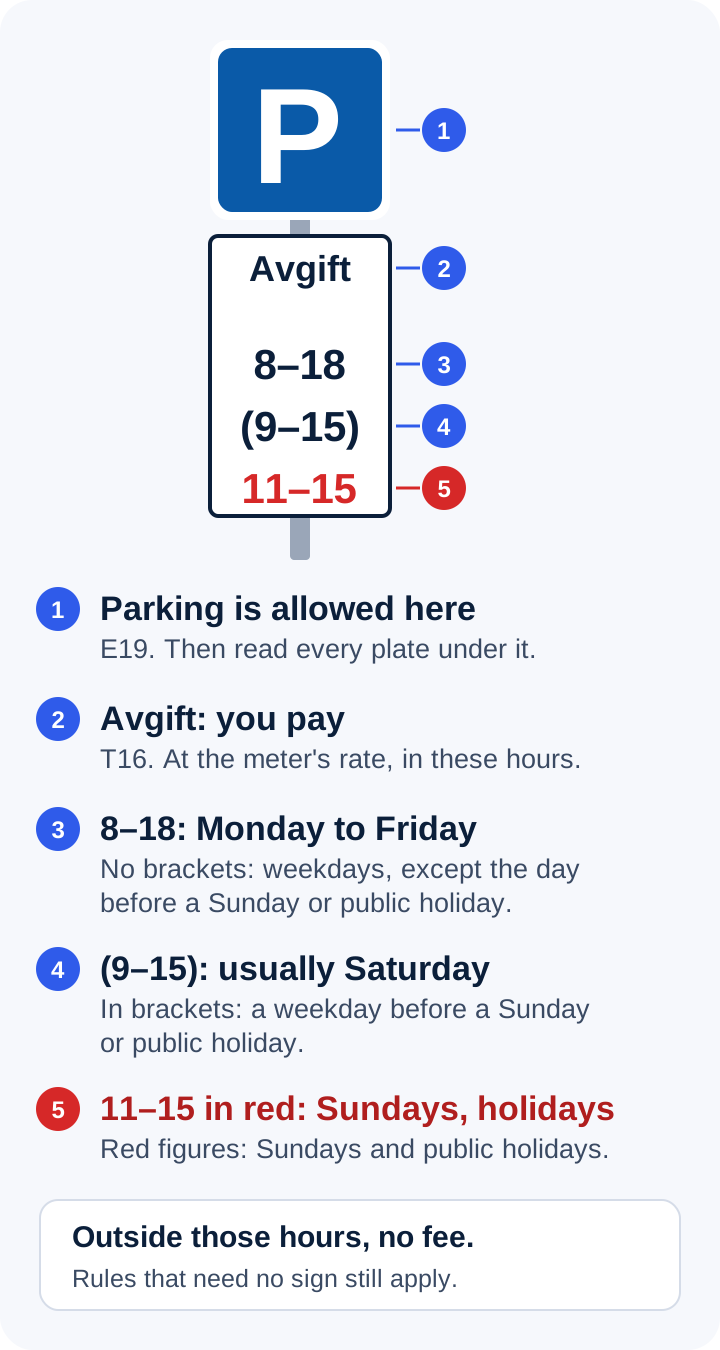
The time plate (T6, Tidsangivelse) shows when the sign's rule applies. When the hours sit on the same plate as a condition, such as a fee or a time limit, they show when that condition applies. Transportstyrelsen gives three rules for the figures:
- Black or white figures with no brackets apply on weekdays, except a weekday before a Sunday or public holiday. In a normal week, that is Monday to Friday.
- Figures in brackets apply on a weekday before a Sunday or public holiday. That is usually Saturday, and also the day before a public holiday that falls in the week.
- Red figures apply on Sundays and public holidays.
Two more rules from the same page: when a time span runs past midnight, the part after midnight belongs to the next day, and a plate that names a date or a weekday applies on that day, whatever kind of day it is.
Reading an example: a P sign with one plate reading Avgift 8–18 (9–15) 11–15, the last figures in red, means you pay from 8 to 18 on weekdays, from 9 to 15 on Saturdays and other days before a holiday, and from 11 to 15 on Sundays and holidays. Outside those hours the fee does not apply. If a plate has no red figures, its condition does not apply on Sundays and holidays at all.
The other plates under the sign
- Avgift (T16): you pay for parking at the rate shown on the parking meter.
- Parkeringsskiva (T17): show the time you parked with a parking disc or something that does the same job.
- Tillåten tid för parkering (T18): the longest time you may park.
- Boende (T19): residents of the area with a special permit may park on special terms.
- Parkeringsbiljett (T20): parking is free, but you need a parking ticket.
- Rörelsehindrade (T7): the space is for vehicles with a parking permit for people with disabilities.
- Symboltavla (T8): the sign applies only to the kind of vehicle or road user shown.
- Avstånd (T2) and Utsträckning (T11): how far away the rule starts, and in which direction it runs. An arrow pointing down shows where it ends.
- Laddplats (T24): a space for charging.
The signs that catch people out
Each of these follows the official rules, but means something different from what it seems to say at a glance.
A plate that says only Avgift: you pay around the clock
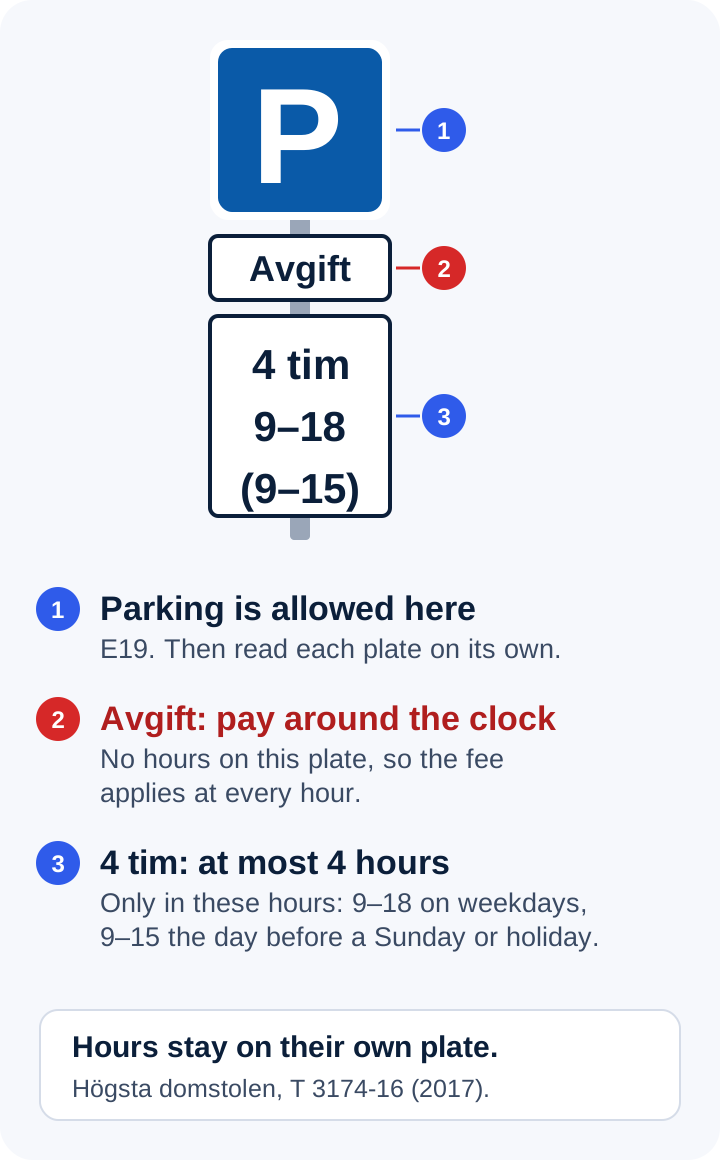
This stack went all the way to the Supreme Court (Högsta domstolen). A P sign had three plates: Avgift, then 4 tim with 9–18 (9–15), then the parking company's details. The driver read it as free parking until 9 in the morning. In August 2017 the court ruled that the fee applied around the clock, and the four-hour limit only in the hours shown.
The court read the plates by the Road Signs Ordinance (vägmärkesförordningen):
- Several plates under one sign: each plate adds its own condition to the sign. It is not extra information about the other plates.
- Several conditions on one plate: they apply together. Avgift 9–18 (9–15) on one plate means you pay only in those hours.
So look at where the hours are printed. Hours on the fee plate limit the fee. Hours on another plate do not.
A no-parking ban that comes back without a new sign
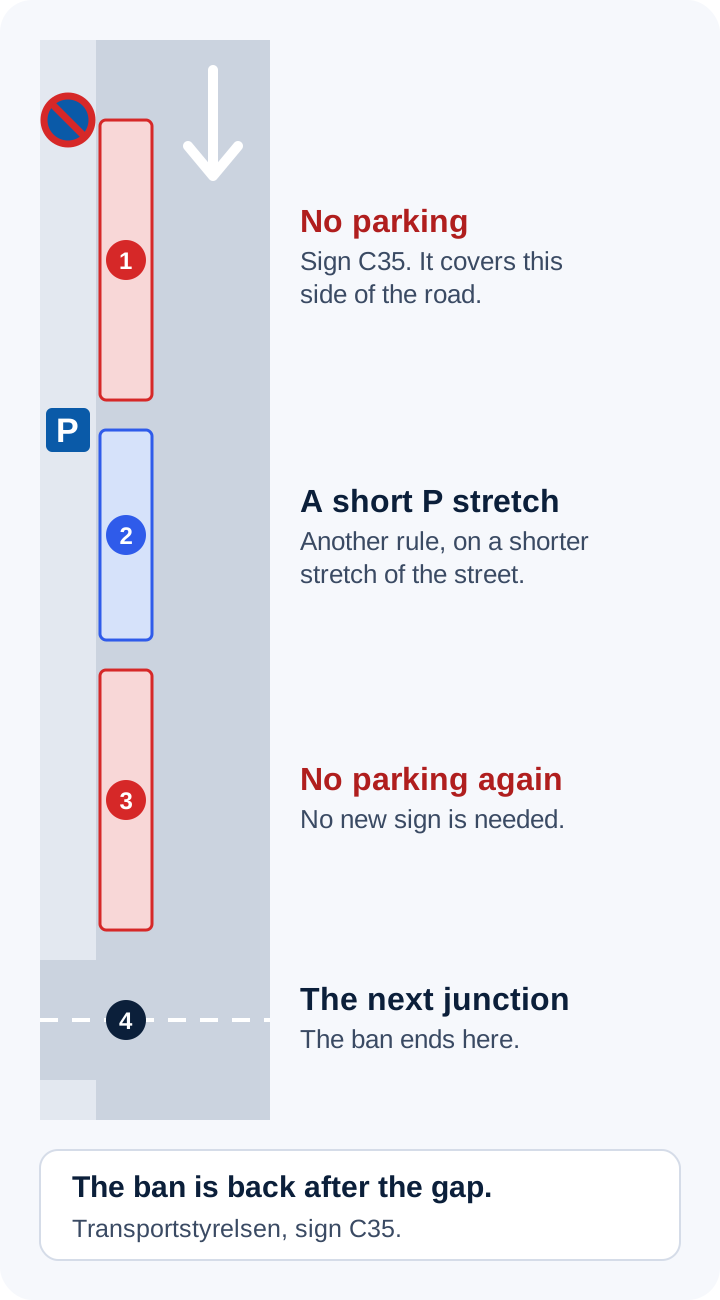
A no-parking sign (C35) covers its side of the road from the sign onwards. Transportstyrelsen adds two details that are easy to miss:
- A short exception is only a gap. When another rule applies on a shorter stretch, the ban applies again where that stretch ends, without the sign being repeated.
- A parking bay does not end it either. Where a parking place has been built beside the carriageway, the ban applies again after it, also without a new sign.
A zone sign you see only once
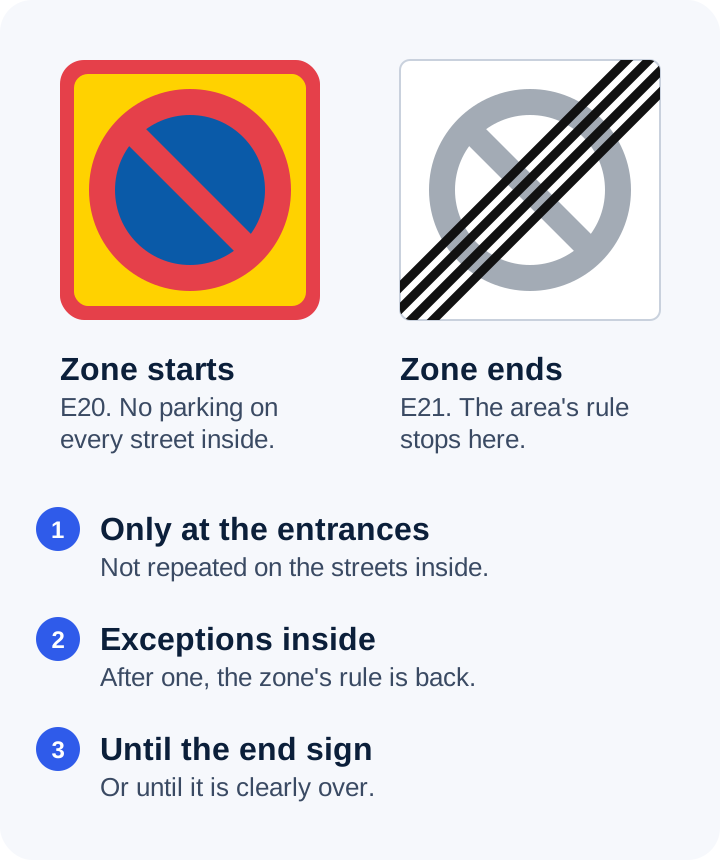
A square sign with another sign inside it (E20, områdesmärke) starts an area where the inner sign's rule applies, for example no parking. It stands at the entrances to the area, not on every street, and applies until the end sign (E21, slut på område) or until it is clear in another way that it no longer applies.
Inside the area, other signs and plates can make exceptions. After each one, the zone's rule applies again without the sign being repeated, and hours can be printed inside the zone sign itself. So if there is no sign on your street, think back to the sign at the entrance to the area.
A weekday on the plate means that day, holiday or not
When a plate names a date or a weekday, its rule applies on that day whatever kind of day it is. The brackets and red figures do not change it. Stockholm's street-cleaning bans work this way: the City says they apply on the weekday and at the time on the signs, even on a public holiday or the day before one.
Watch the hours too. A ban from 0 to 6 on a Tuesday starts at midnight, so a car left on the street on Monday evening is already inside it.
A panel with a sign inside it: E30 and C45
Some signs come as a panel with a smaller sign and its conditions printed inside, hung under another sign.
- A blue panel with a P (E30, särskilda bestämmelser för parkering), for example P 30 min 8–18: parking is allowed on the conditions inside it. Under a no-parking or no-stopping sign, it can be an exception to that ban.
- A yellow panel with a red border and a ban inside (C45, särskilda bestämmelser för stannande och parkering), for example no parking 8–18: it states that ban, and can change the rule of the sign it hangs under, such as a P sign.
Hours inside either panel follow the time-plate rules above.
Lastplats: a space for loading
A yellow sign with a red border that reads Lastplats above a no-stopping symbol marks a space kept for a purpose (C40, ändamålsplats). Its purpose is loading or unloading heavy or bulky goods.
Laddplats: only cars that can be plugged in
A plate showing a car plugged into a charging post (T24, laddplats) under a P sign means only vehicles that can be charged with electricity from outside, to drive on, may park there. A petrol or diesel car may not, and neither may a hybrid that cannot be plugged in. Every other plate on the post, such as a time limit, still applies on its own.
A P sign on private land
Not every P sign is put up by the municipality. A landowner, or a company running the car park under an agreement, can charge a control fee (kontrollavgift) under its own law. It is not a parking fine.
- Signs first: the fee can be charged only if the ban or the conditions are clearly shown with road signs on the spot.
- A cap: it may not be higher than the parking fine the municipality has set for that area and that kind of breach.
- 24 hours: under a P sign a landowner has put up, you may park at most 24 hours in a row on weekdays, except the weekday before a Sunday or holiday, unless a plate says otherwise.
- Who to contact: the Police handle only fines issued by the Police or the municipality. For a control fee, the Police say to contact whoever issued it, and a court case over one goes to the district court (tingsrätten) where the car was parked.
Rules that apply with no sign
The Traffic Ordinance, chapter 3, sets these rules everywhere. A parking sign does not lift them.
- Right-hand side only. On a road you may stop or park only on the right-hand side in the direction you are driving, with exceptions such as one-way streets (52 §).
- Crossings: no stopping or parking on, or within 10 metres before, a pedestrian crossing or a cycle crossing (53 §).
- Junctions: no stopping or parking in a junction or within 10 metres of the nearest edge of the crossing road (53 §).
- Bus stops: where the stop is not marked on the road, no stopping or parking from 20 metres before to 5 metres after the bus-stop sign (54 §).
- No parking within 30 metres of a level crossing, in front of an entrance to a property so that it is hard to drive in or out, or on a main road (huvudled) (55 §).
- Inside the lines: where spaces are marked, no wheel may be outside the space (49 §).
- 24 hours: on public places in built-up areas and on public roads, a car may stand at most 24 hours in a row on weekdays, except the weekday before a Sunday or holiday (49 a §).
- Not on the grass: in built-up areas, no stopping or parking on public land that is not a road or a paved place, such as a lawn (48 §).
Date parking and street-cleaning nights
Date parking (datumparkering, sign C38): on days with an even date you may not park on the side of the street with even house numbers, and on odd dates not on the side with odd numbers. The hours are set locally, not nationally. One municipality's rule bans parking from 2 to 16, another's from 0 to 12, so check the local rule or ask the municipality.
Street cleaning (servicetid, städning): many streets have a weekly time when parking is banned so the street can be cleaned. The City of Stockholm says the ban applies on the weekday and at the time the signs show, also on holidays and the day before a holiday, and that the signs on the street decide. Göteborg says the same: what the sign says is what applies.
What a parking fine costs, and how to dispute it
- Who sets it: the municipality sets the parking fine (felparkeringsavgift). The Government's ordinance allows between 75 and 1,300 kronor.
- Who issues it: a police officer or a parking attendant.
- Late payment: the fine goes up by 150 kronor if it is still unpaid after a reminder.
- Disputing it: the Police say you must pay the fine before you can dispute it, and the dispute must reach the Police within six months. A control fee on private land works differently (see above).
- Towing: a car can be moved when that is needed for order and safety in traffic, and the owner pays for the move. In Stockholm, the fees must be paid before the car is handed back.
Parking permit for people with disabilities
The municipality where you are registered decides on a parking permit for people with disabilities (parkeringstillstånd för rörelsehindrade). It is valid in all of Sweden. It lets the holder park, for example, for up to three hours where a local rule bans parking, and in spaces marked for permit holders. It does not cover spaces kept for another purpose.
A quick check before you walk away
- Main sign: is parking allowed or banned, and on which side?
- What kind of day is it: a weekday, the day before a Sunday or holiday, or a Sunday or holiday? Read the matching figures.
- Every other plate, each on its own: a fee, a disc, a ticket, a time limit, a vehicle type, residents only? Hours count only for the plate they are printed on.
- No sign on your street? Think back to the entrance of the area, where a zone sign may cover it.
- Distances: 10 metres before a crossing, 10 metres from a junction, the bus stop, the entrance.
- Date parking or a cleaning night tonight?
- Leaving the car for long? On weekdays it may stand at most 24 hours in a row.
Thinking about whether to keep a car at all? Read do you need a car in Sweden, and for your licence, how to get a Swedish driving licence.
Frequently Asked Questions
What do the numbers in brackets mean on a Swedish parking sign?
Figures in brackets are the hours that apply on a weekday before a Sunday or public holiday, which is usually Saturday. Figures without brackets are the other weekdays, normally Monday to Friday.
What do red numbers mean on a parking sign in Sweden?
Red figures are the hours that apply on Sundays and public holidays. If the time plate has no red figures, its rule or fee does not apply on those days.
Can I park for free outside the hours on the sign?
The sign's condition, such as a fee or a time limit, applies only in the hours on the time plate. Outside them, the rules that need no sign still apply, for example at most 24 hours in a row on weekdays.
How long can I park on a street in Sweden?
Unless a sign says otherwise, a car may stand at most 24 hours in a row on weekdays on public places in built-up areas and on public roads, except the weekday before a Sunday or holiday.
How much is a parking fine in Sweden?
The municipality sets it, between 75 and 1,300 kronor. It goes up by 150 kronor if unpaid after a reminder. You pay it first and then dispute it with the Police.
If a plate says only Avgift, when do I have to pay?
Around the clock. Each plate under a sign is read on its own, so hours on another plate do not limit the fee. Only hours on the Avgift plate itself, such as Avgift 9–18 (9–15), limit when you pay. The Supreme Court ruled this way in 2017 (T 3174-16).
Is a control fee (kontrollavgift) the same as a parking fine?
No. A landowner, or the company running a private car park, charges a control fee under the law on control fees. It may not be higher than the municipality's parking fine. The Police handle only fines issued by the Police or the municipality, so for a control fee you contact whoever issued it.
Moving for work? How Settio helps
Settio helps employers and immigration and relocation agencies run the whole move in one place, so the person moving can focus on settling in:
- Before the move: one plan for the permit and the move, with every step and deadline. A partner and children get their own steps in the same household.
- After arrival: the employee portal shows the newcomer their next steps on their phone, in their language, from registering after arrival to help for settling in.
- When the permit runs out: permit monitoring flags the extension in good time.
HR teams and agencies can start for free. Moving yourself? Try our free tools for life in Sweden.
Sources
28 official sources
- Transportstyrelsen: Vägmärken
- Transportstyrelsen: E19 Parkering
- Transportstyrelsen: C35 Förbud mot att parkera fordon
- Transportstyrelsen: C39 Förbud mot att stanna och parkera fordon
- Transportstyrelsen: C38 Datumparkering
- Transportstyrelsen: Tilläggstavlor
- Transportstyrelsen: T6 Tidsangivelse
- Transportstyrelsen: T16 Avgift
- Transportstyrelsen: T18 Tillåten tid för parkering
- Transportstyrelsen: T24 Laddplats
- Transportstyrelsen: E20 Områdesmärke
- Transportstyrelsen: E21 Slut på område
- Transportstyrelsen: E30 Särskilda bestämmelser för parkering
- Transportstyrelsen: C45 Särskilda bestämmelser för stannande och parkering
- Transportstyrelsen: C40 Ändamålsplats
- Högsta domstolen: dom den 18 augusti 2017, mål T 3174-16
- Riksdagen: Lag (1984:318) om kontrollavgift vid olovlig parkering, 1 to 4 and 9 §§
- Riksdagen: Trafikförordning (1998:1276), 3 kap. 47 to 55 §§
- Transportstyrelsen, local traffic rules: Umeå 2025:36, datumparkering
- Transportstyrelsen, local traffic rules: Haninge, datumparkering
- City of Stockholm: Servicetider
- City of Göteborg: Så städar vi staden
- Riksdagen: Lag (1976:206) om felparkeringsavgift
- Riksdagen: Förordning (1976:1128) om felparkeringsavgift, 2 a and 2 b §§
- Polisen: Parkeringsanmärkning
- Riksdagen: Lag (1982:129) om flyttning av fordon i vissa fall
- City of Stockholm: Fordonsflytt
- Transportstyrelsen: Parkeringstillstånd för rörelsehindrade
More in our guide toRelocating to Sweden
Know someone who needs this? Send them the link.